



TL;DR
Signatures, stamps, and seals are critical markers of authenticity in documents. Yet detecting these elements remains difficult because they vary widely in form, placement, and quality. Traditional OCR and template-based systems often fail to capture them reliably, treating these visual elements as noise or skipping them entirely.
Agentic Document Extraction (ADE), powered by LandingAI’s DPT (Document Pre-Trained Transformer) model family, introduces an attestation chunk type that explicitly identifies and structures these elements as part of the document’s layout. By treating each attestation as a single structured object, ADE preserves its layout and spatial context, enabling precise, audit-ready extraction at scale.
This vision-based, layout-aware approach ensures that every signature, stamp, and seal is detected and represented consistently, reducing manual review and bringing end-to-end reliability to document verification workflows.
Introduction
Signatures, stamps, and seals are the foundation of trust in documents. From contracts and notarized forms to certificates and patient consents, they verify authenticity, approval, and accountability. For regulated industries, a missing attestation is more than a formatting issue. It can invalidate a document or halt a process entirely.
Despite their importance, these visual elements are a persistent challenge for automated systems.In real-world documents such as financial statements, insurance forms, or legal agreements, signature blocks and official seals appear alongside text, tables, and images. Traditional OCR pipelines often skip them entirely, treating ink strokes as noise or unreadable graphics. Template-based systems, on the other hand, fail when layouts shift or seals appear in unexpected locations. The result is incomplete extraction, manual correction, and gaps in compliance workflows.
Agentic Document Extraction (ADE) was built to handle exactly this kind of complexity. Unlike text-first pipelines, ADE is Visual AI-First. It understands documents as visual entities, not just collections of text. Its agentic system plans and decides how to extract data consistently across varying layouts and formats.
To specifically address attestations, ADE introduces an attestation chunk type that identifies and structures signatures, stamps, and seals as part of the document layout. It detects each attestation, grounds it spatially within the page, and represents it as structured data in the output. This ensures every signature or seal is captured with context and precision.
In this post, we’ll explore how ADE detects and structures attestations across a diverse set of real-world documents, from healthcare reports and financial forms to legal agreements.
Chunk Types and the Attestation Chunk
ADE organizes documents into semantic chunks, each representing a coherent unit such as text, tables, or figures. Every chunk carries metadata that defines its type, content, and position on the page. This layout-aware structure preserves how information appears and relates visually within a document.
Out of these chunk types, attestation chunk type is specially designed for signatures, stamps, and seals, treating them as structured components within the layout. The attestation chunk isolates these elements visually and links them with their surrounding context, ensuring they are detected and represented accurately in the extracted output.
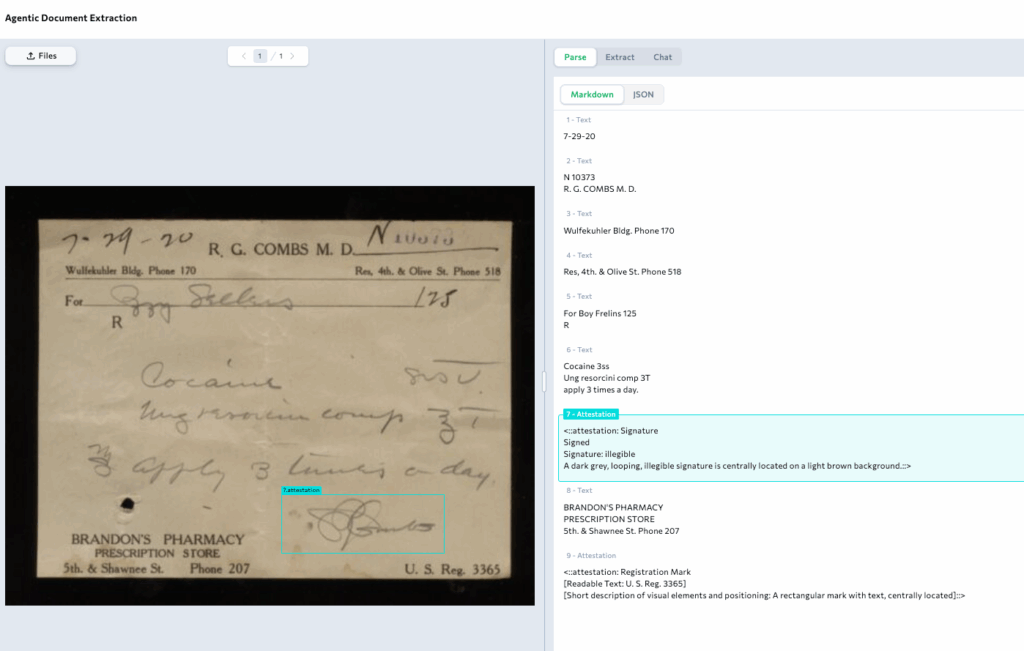
Here’s an example of ADE marking a handwritten signature as an attestation chunk within a historical prescription document. Even though the ink is faded and the handwriting is difficult to read, ADE still identifies the signature block clearly as signed and anchors it to its position on the page.
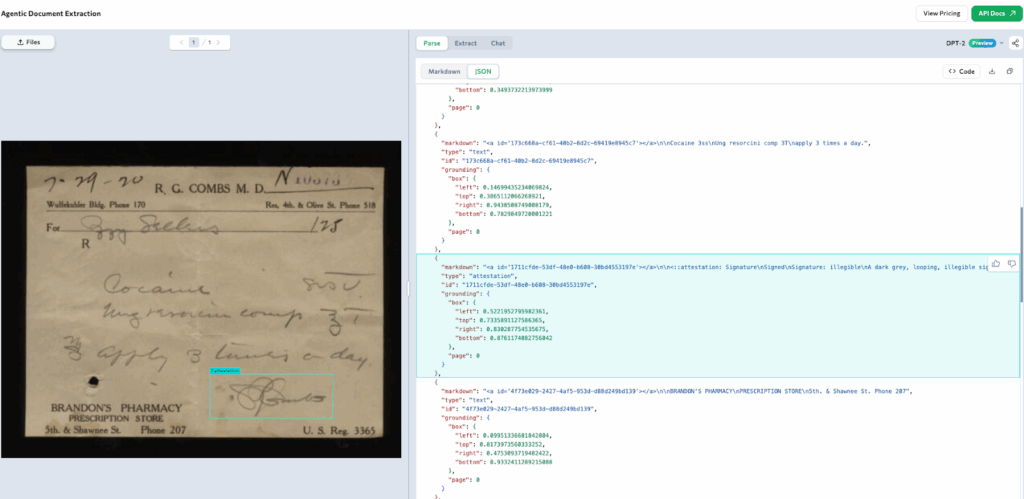
Each attestation is also represented as a structured data object, including its type, text content, and bounding box.
Now that we’ve seen how ADE captures attestations at the chunk level, let’s look at more examples across a range of real-world documents.
Healthcare
Example: Lab Report
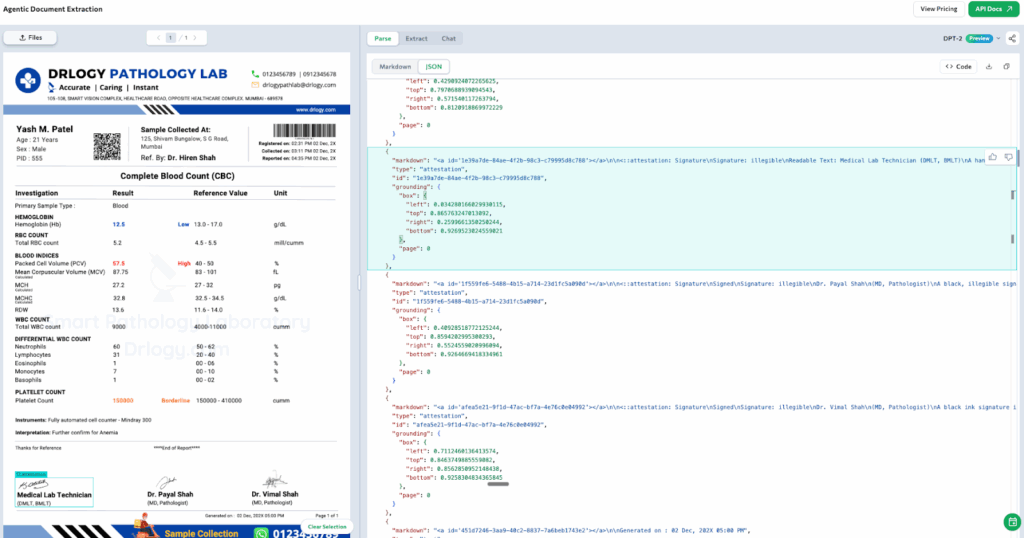
This example shows how ADE detects attestations in medical lab reports, a document type where accuracy is critical. Lab reports often include multiple sign-offs from technicians, pathologists, and medical directors, each confirming test validity and diagnosis. Traditional OCR systems struggle to recognize these handwritten or scanned signatures, especially when they overlap printed text or appear in varying positions.
In this case, ADE accurately identifies three distinct attestation chunks, each corresponding to a different medical professional. It isolates every signature, captures its location within the report, and preserves the surrounding text such as titles and credentials. This makes it possible to verify report authenticity automatically and maintain a clear audit trail without manual intervention.
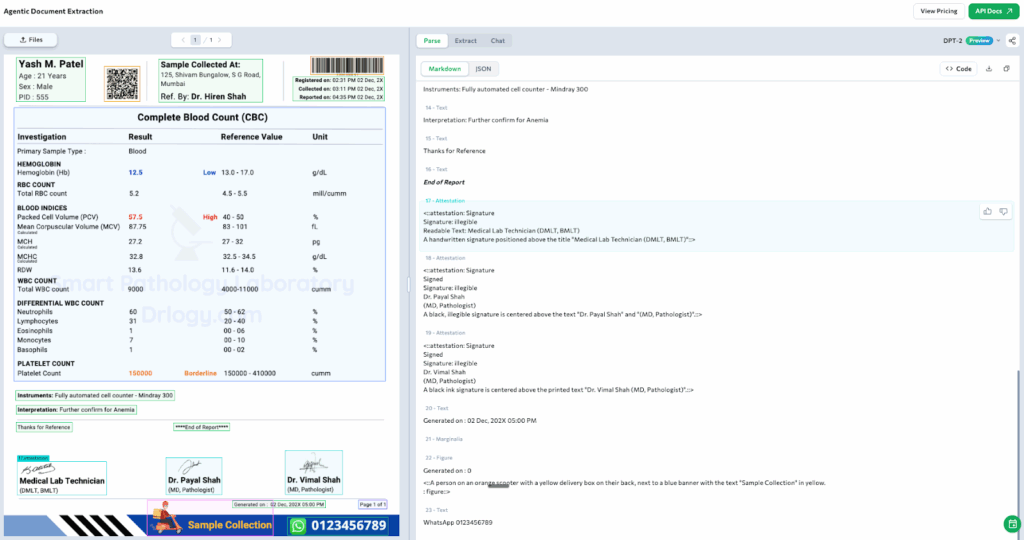
Each attestation is also represented in the structured JSON output, including its bounding box, subtype, and text content.
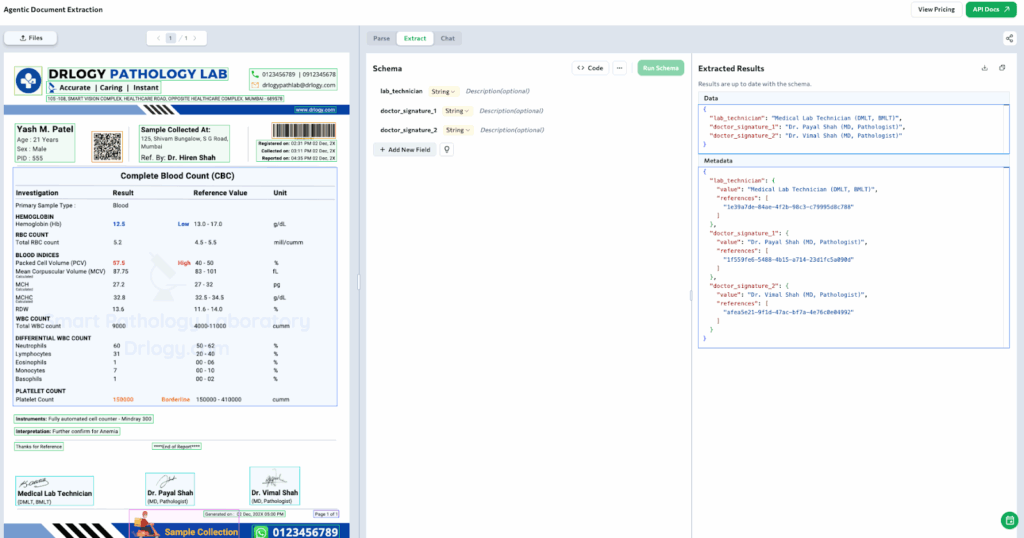
Beyond parsing, ADE also supports extracting specific fields using custom schemas. In the example below, fields such as lab_technician, doctor_signature_1, and doctor_signature_2 are defined in the schema. ADE automatically maps each field to the corresponding attestation region on the page and extracts the relevant details. This enables field-level validation and supports downstream automation across medical workflows.
Example: Handwritten Doctor Prescriptions
This example highlights how ADE identifies attestations in handwritten prescriptions, one of the most variable and unstructured document types in healthcare. Prescriptions often combine printed letterheads, handwritten notes, and doctor signatures that differ in placement, size, and clarity.
In this prescription, ADE detects both the doctor’s handwritten signature and the official practice stamp as attestation chunks and links them to the accompanying printed details such as name, qualifications, and contact information.

Finance & Banking
Example: KYC and Onboarding Forms
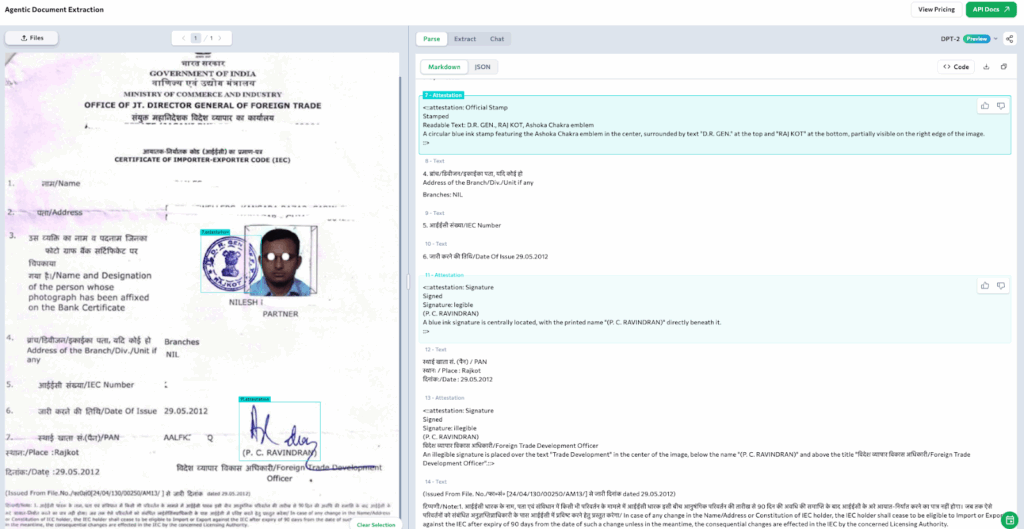
KYC documents play a crucial role in financial verification. They include government-issued forms, identity proofs, and trade certificates that often carry multiple attestations confirming authenticity. These signatures and official seals are critical for compliance, yet their formats and placements vary widely across documents and languages.
In this example, ADE processes an Importer-Exporter Code (IEC) certificate, a registration document used in India for international trade. The certificate includes both English and Hindi text, an official blue ink stamp, and multiple handwritten signatures. ADE detects each of these attestation elements precisely, identifying the stamp, reading the surrounding bilingual text, and extracting the signer’s name and designation from printed fields.
Example: Remittance and Transaction Forms
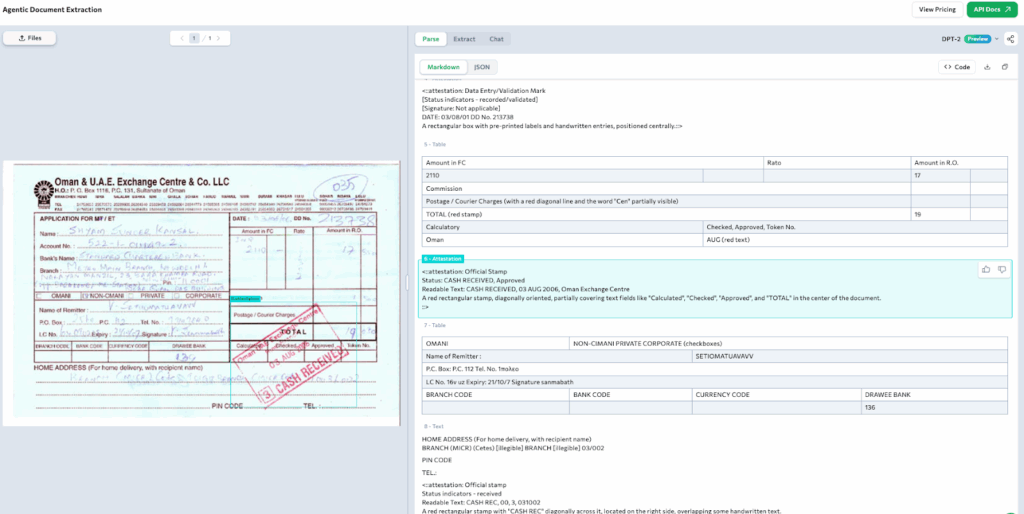
Financial documents often contain a mix of handwritten details, printed tables, and multiple official stamps for validation or approval. These stamps are critical for transaction authenticity.
In this example, ADE processes a remittance form issued by a foreign exchange center. The document includes red diagonal stamps labeled “CASH RECEIVED” along with handwritten entries and tabular data. ADE detects the stamp as a distinct attestation chunk, identifying their color, position, and readable text even when they overlap with form fields.
Legal & Compliance
Example: Affidavits and Declarations
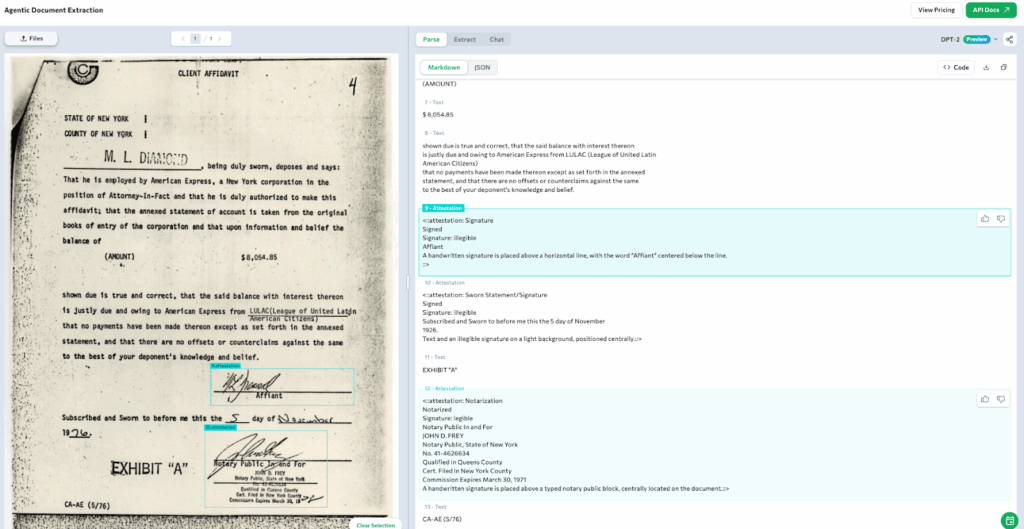
Legal affidavits are often scanned copies of historical or notarized documents, where clarity varies with age and condition. Despite faded text, creased paper, and uneven scans, ADE accurately identifies each attestation, preserving both the content and spatial positioning of every signature and seal.
In this example, a sworn affidavit includes multiple signatures — from the affiant, the notary public, and the certifying authority. ADE captures each attestation as a distinct chunk, reading legible details such as the notary’s name, title, and jurisdiction, while maintaining visual grounding within the page. Even with handwriting variations and low-contrast ink, every signature is extracted with precise bounding boxes and contextual descriptions.
Example: Contracts and Official Proclamations
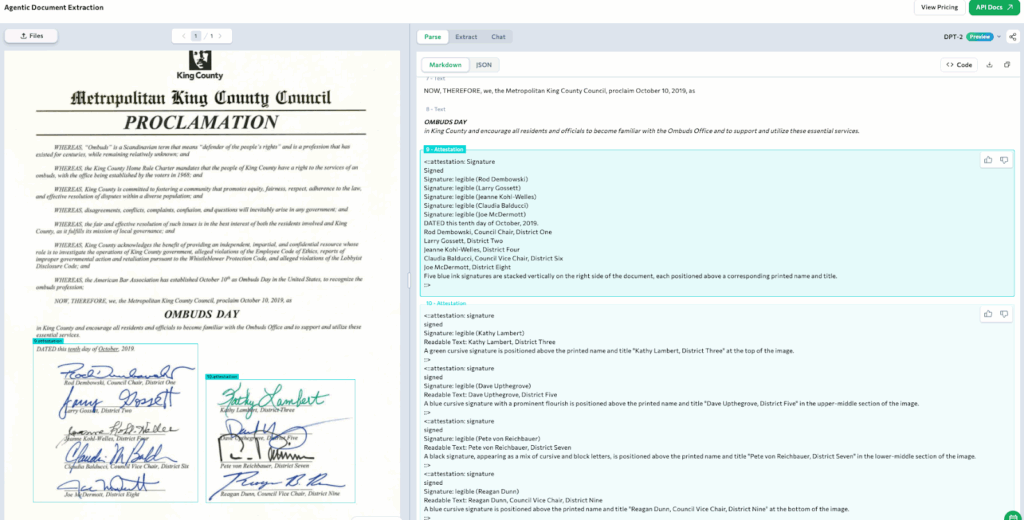
Legal and government-issued proclamations frequently involve multiple signatories, each representing a different office or authority. In such documents, signatures are often layered or arranged vertically, accompanied by printed names and titles.
In this proclamation example, ADE identifies several distinct attestation chunks, each corresponding to an individual council member. It detects the placement, color, and style of each handwritten signature, linking it with the associated printed role such as “District Chair” or “Vice Chair.” By structuring these attestations together, ADE provides a clear, machine-readable record of who signed, where, and in what order.
Conclusion
From lab reports and prescriptions to trade certificates and affidavits, attestations are the backbone of document authenticity. Yet they are among the hardest elements to detect and structure accurately.
With the attestation chunk, ADE captures signatures, stamps, and seals as structured data within the document layout. Each attestation is extracted with its position and context preserved, ensuring nothing important is lost.
This makes document verification faster, more consistent, and fully auditable across industries, turning a manual review step into a reliable, automated process.
Ready to get started?
Test ADE live with your documents in the Visual Playground.