From Zero to Automated Document Workflows: Hands-on with OCTO & Agentic Document Extraction


LandingAI Team and TCG PROCESS
The Real Challenge: Intelligent Extraction With Proper Orchestration
AI extraction has reached a turning point. Models can now reason through document structure and variation with minimal configuration—which means the real opportunity lies in how quickly organizations can deploy that intelligence at scale, inside a secure, controlled environment.
But here’s the thing: having a capable extraction model is only part of the equation. Solution architects and IT teams know the real challenges come after the demo—fragmented processes, manual exception handling, brittle integrations, and orchestration gaps that demand custom code. These are the reasons many AI pilots stay stuck in proof-of-concept mode.
We believe the key to moving forward is combining intelligent extraction with proper orchestration. That’s the thinking behind TCG Process’s work with LandingAI.
What is Agentic Document Extraction?
LandingAI’s Agentic Document Extraction (ADE) takes document processing beyond text recognition to true document understanding. Using a human-like, agentic approach, ADE interprets structure, layout, and context together — much as a person would when reading a document — rather than treating content as isolated words or fields.
This contextual understanding dramatically reduces the need for manual configuration and enables reliable automation across high-volume, highly variable documents. As a result, ADE opens up new use cases that were previously difficult or impractical to automate, including:
- Parsing highly variable forms, contracts, and insurance applications without pre-defined templates.
- Accurately interpreting identity documents (e.g., passports, driver’s licences) that contain layered security features and diverse spatial layouts.
- Extracting complex tables, charts, and mixed-media elements into structured, context-rich representations.
- Converting decades of archived multimodal documents into searchable, AI-ready data
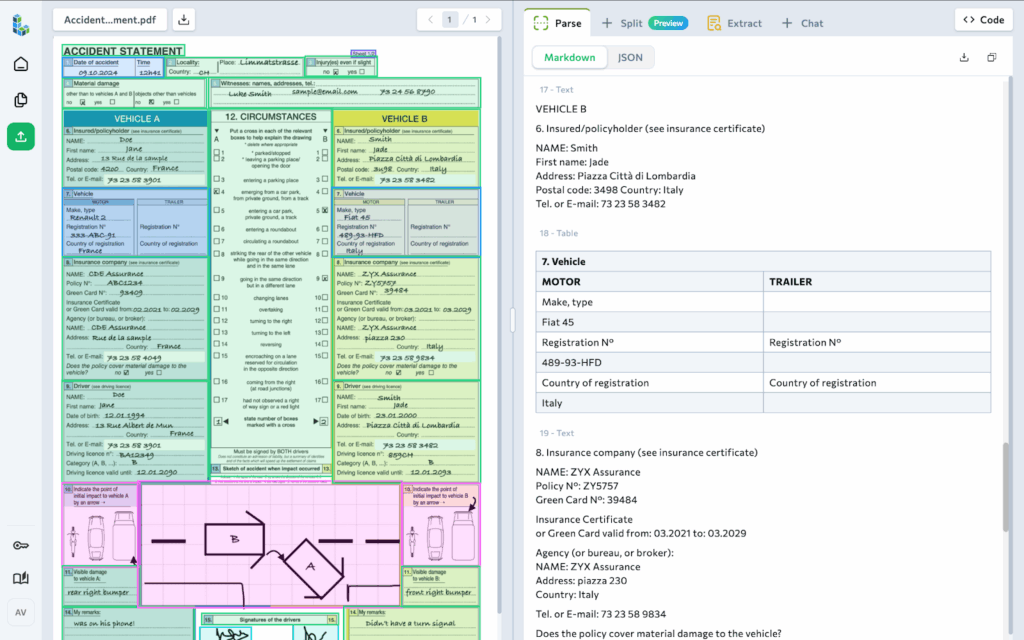
LandingAI Agentic Document Extraction Playground Example
From Extraction to Execution: Scalable, Observable Automation with OCTO
OCTO, an AI-driven intelligent process automation platform from TCG Process, acts as the orchestration layer that turns ADE’s intelligence into governed, repeatable business processes. We’ve built ADE integration as a native service within OCTO, which means you can deploy extraction directly inside a broader process without building custom plumbing.
Together, these two platforms deliver something we think has been missing: a way to deploy agentic extraction quickly while ensuring the underlying automation is scalable, observable, and maintainable. That combination matters, especially in regulated industries where visibility and control aren’t optional.
Building a Process with the OCTO AI Assistant
OCTO AI Assistant accelerates process application design by turning natural language into executable process models. Users can describe what they want in plain English, and OCTO automatically builds the underlying process, complete with structured activities and application frameworks. As it designs the process, OCTO also generates clear, detailed documentation—making solutions easier to understand, govern, and maintain. By connecting to external knowledge sources (such as the LandingAI ADE schema), the assistant enriches processes with additional context and intelligence, helping teams design smarter, more valuable automation use cases from day one.
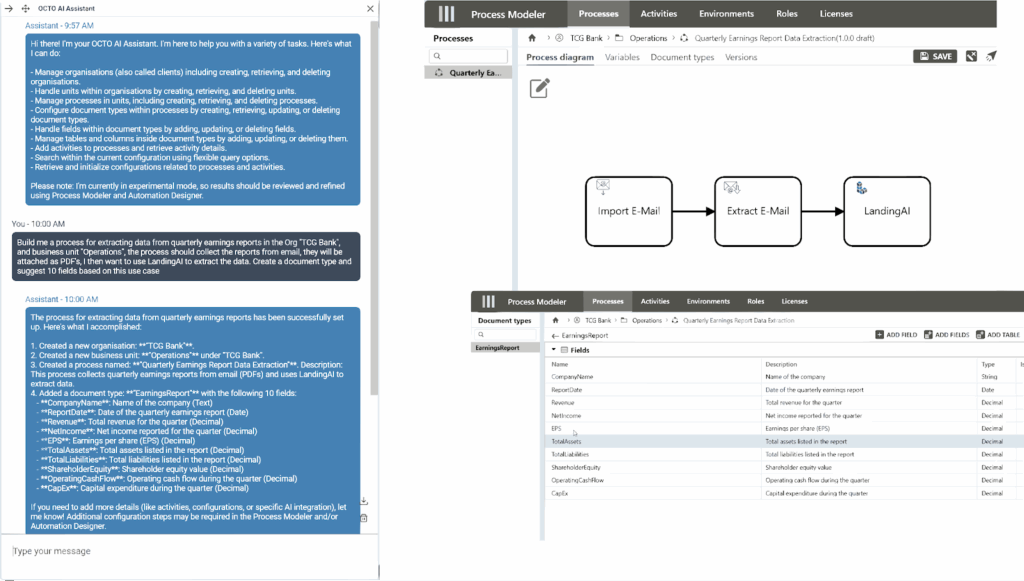
A Screenshot of OCTO AI Assistant
Reusable Activities That Speed Up Process Design
One challenge we hear consistently from solution architects is the need to avoid rebuilding every time a new automation opportunity comes up. OCTO addresses this with reusable processes, pre-built activities for ingestion, routing, exception handling, that allow teams to replicate successful patterns across departments and use cases.
The Full Process: Ingestion to Extraction to Output
We’ve built a complete process in about 15 minutes. Here’s the flow:
1. Documents come in through OCTO’s omnichannel connectors
2. ADE extracts structured data, handling document variation automatically
3. OCTO applies business rules—completeness checks, fraud flags, logic, compliance routing
4. HITL – Exceptions route to human review; clean cases achieve straight-through processing
5. Results integrate with downstream systems—CRM, loan origination, core banking, or whatever else you need

What This Delivers
The real benefit here isn’t just speed—it’s what speed enables: reduced cycle times, increased accuracy, lower manual review workload, and consistent compliance controls. When you can stand up a governed process this quickly, you’re not just automating faster; you’re creating a foundation that scales.
- 80%: The average time reduction in model deployment
- 100% Visual traceability for audit and compliance
- 90% reduction in time spent searching for information
From Pilot to Production
At TCG Process, we believe intelligent extraction must be part of something larger to deliver real business value. LandingAI’s ADE handles the intelligence and OCTO ensures that intelligence flows through a controlled, orchestrated, enterprise-ready process. For organizations ready to move past the pilot stage, this combination offers a practical path forward.
Want to see how this works? Join us for a hands-on session where we build a complete process from scratch—live, in under 15 minutes. Register now for the January 21 (Wednesday) live webinar!
FAQ
What makes ADE different from other extraction approaches?
It uses a human-like, agentic approach to interpret structure, layout, and context together, allowing it to handle highly variable documents with minimal configuration and unlock automation use cases that were previously out of reach.
Why do we need orchestration if ADE already provides the intelligence?
AI models don’t execute business processes—they generate outputs that still need to be validated, routed, and acted upon. OCTO handles ingestion, routing, validation, exception management, and system integrations. It also provides the visibility, control, and auditability needed to deploy AI responsibly.
Can this architecture meet strict compliance requirements?
Yes. OCTO provides traceability, versioning, governance, and full visibility into each process step. It’s designed for regulated industries: banking, insurance, government—where these capabilities aren’t nice-to-haves.
How does this make automation easier to scale?
Once ADE is integrated with OCTO, teams can replicate the same orchestration patterns across multiple document-driven processes. That reduces development time and brings consistency to automation across the enterprise.