Team Stories about ADE Gen2: Engineers on Camera

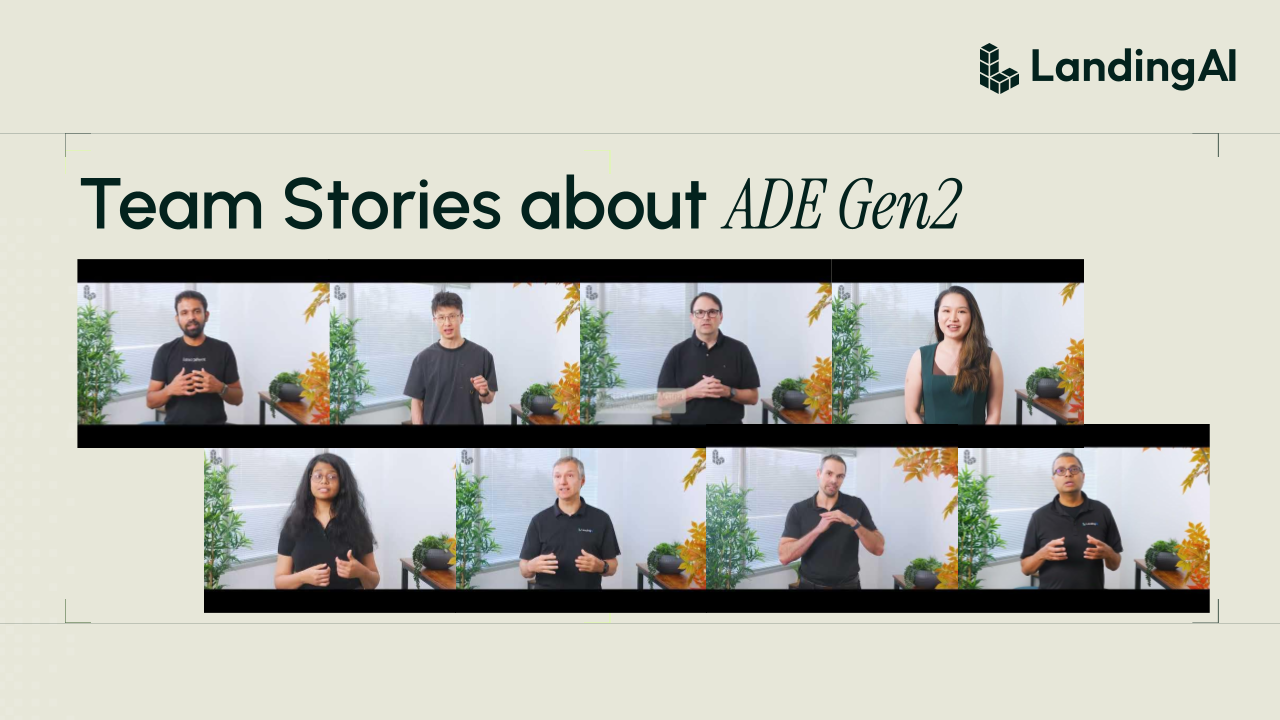
We pointed a camera at some of the people who built Agentic Document Extraction Second Generation and asked them short questions. In the playlist below you get the rare chance to hear directly from the experts.
- What are you most excited about?
- What are you proudest of?
- What turned out harder than it looked?
- What would you show a customer first?
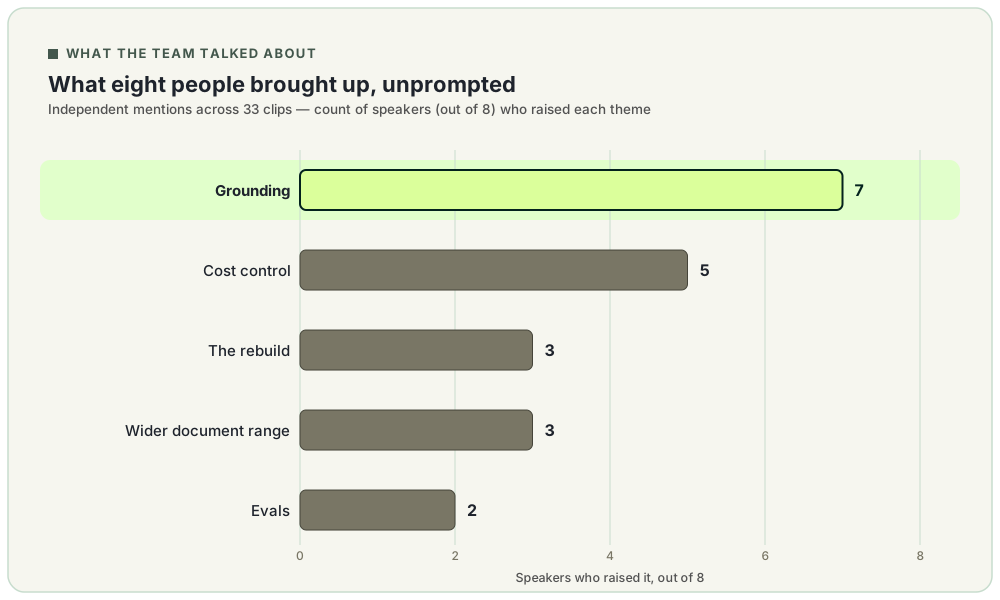
Since we asked each person individually, they didn't know what the others had said in response to the same question. That gave us a chance to do a summary analysis to see what topics rose to the top across our 8 interviewees.
Everybody wanted to talk about document grounding
Seven of the eight raised document grounding unprompted, which makes it the closest thing this release has to a consensus.
Daniel Bibireata, VP Engineering, gives the cleanest before and after. The previous generation pulled semantic content out of a document and grouped it well, but it could not pinpoint a location on the page. Second Generation understands the document hierarchically, so you can move from a section to a paragraph to a line to a specific value or form field. He connects that straight to trust: a customer who can see the exact spot a value came from can confirm it is correct.
Ava Xia, Applied AI Engineer, puts a number on it: one bounding box per rendered line, which is what makes sentence-precise citations possible. Fatima Salehbhai, Product Manager, points out that grounding at the field level inside extraction was not available before, and that it opens up work nobody asked for last year, like redacting a document at a granular level or comparing two documents field by field.
Shankar Jagadeesan, Machine Learning Engineer, sees developers building document traceability applications straight off the API response, with visual cues fine enough to make an audit faster to run. Quinn Killough, Sales Director, works with enterprises in regulated spaces and is blunter about why it matters: linking a value back to exactly where it came from is the requirement in those industries, and tighter grounding takes time out of human review and audit.
Ankur Rawat, Engineering Chief of Staff, calls the jump in granularity a major step up in the core technology. Two of the clips reach for the word "word" when describing how far down you can go. What shipped is atomic citations, which live in Extract V2 alongside the infinite schema and the Extract Jobs API, and the character is the atomic unit by design. Word-level spans and configurable citation levels are Fast Follower.
The unglamorous work that decides whether any of it is true
Two of the eight, asked independently, named evaluation as the least flashy thing that matters most.
Shankar's version: evals are hard because documents are diverse. Any single customer has a finite set of document types. The team has to make sense of all of them. The eval process built to cover that spread is the win he is proudest of, and customers will never see it.
Fatima describes the same work from the inside: countless passes during model building, with machine learning engineers, the engineering team, labelers, and product all going through results by hand to verify and improve them.
What rides on those evals is a list of small things that break documents.
- Checkboxes, for one. They are tiny, usually parked in a corner of the page, and brutally diverse: ticks, crosses, shading, circles drawn around an option. Get one wrong and the meaning of the whole document can invert.
- Figures, for another. A single figure can hold a visual, a caption embedded inside it, and labels on both axes. Second Generation separates the generative part of a figure (explaining a chart as a table, for instance) from the transcriptive part, then interleaves the two.
Then there are key-value pairs, which have to be read the way a human reads them rather than in page order. Fatima's example is the plainest available: an invoice number has to end up attached to the actual invoice number. The hard version of that problem is what Shankar calls non-linear documents, forms with no definitive reading order, where the eye zigzags across the page to bind a key on the left to its value somewhere off to the right. Cracking grounding on those is his mic-drop moment, and it is his featured clip below.
Daniel adds the part nobody films. A first cut of Second Generation came together fast. Getting from a prototype that looks most of the way there to something that handles every edge case and every scalability problem in a production stack took sustained research from the machine learning team and sustained engineering from the software team. People see the finished result without seeing the distance covered to reach it.
They built it again from the ground up
Matias Cuenca-Acuña, Sr. Principal Engineer, is the one person who did not talk about grounding. He talks about the rebuild. The team reinvented the whole platform and rebuilt parsing and extraction from the ground up, because a document can contain hundreds of thousands of individual pieces, and doing that work at both scale and speed is a hard problem. He is proudest of a new approach to that complexity that returns results faster and more reliably.
Mingrui's proudest work sits next to that: a redesigned engineering infrastructure, and an API that is more stable and more scalable than before. Daniel's angle is who the rebuild was for. The team built Second Generation following the principles of agent-centered design. They used AI and agents and designed the APIs for agent-centered consumption, expecting that the developers using them will reach for them through agents too.
Matias also raises something no other clip touches, and it deserves the room. The work on the VPC solution means Second Generation now accommodates more customer environments, specifically the ones where customers face real constraints on accessing LLMs. That work is what lets a regulated buyer deploy the capability at all.
Cost stops being one flat price
Five of the eight talked about the cost of document extraction, from five different directions.
Fatima's looks furthest ahead. Intelligent routing is a Fast Follower, and once it lands it will mean accurate extraction across all kinds of documents without paying the highest cost for every type, so simpler documents cost less. She also has the clearest read on demand. Customers have waited months for DPT-3 Verity, in preview with this release, because they want high accuracy on simpler documents without paying the full agentic cost when the job does not require it.
Quinn sees the same model from the field: it makes well-established, simpler workflows a drop-in, with fewer edge cases to work through before a team can trust it.
Ava's answer is the least visual and the most useful. The options parameter in Parse is the lever on token usage and API cost at scale. You choose the elements you want parsed and drop the ones you do not need, barcodes and scan codes among them, which means the content returned can be a subset of the page.
Mingrui frames the same idea as control: more options on input and output, and users deciding what comes back. Matias adds the tier choice, where customers pick a service tier and decide between saving money and getting a faster turnaround.
The pile of documents you can point this at got bigger
Quinn describes a pattern he keeps seeing in enterprise accounts. Customers ran ADE on their hardest documents and left the run-of-the-mill ones to traditional OCR tooling. Second Generation covers that entire swath, giving teams one tool for document extraction instead of several stitched together.
Ankur takes the widest view in the set. Billions of document repositories worldwide become computable, and businesses can pull real intelligence out of them. That was previously impossible, or humanly impractical and cost prohibitive. Tools have existed for decades, but the state of the art among them was limited in what it could extract, what kinds of documents it could handle, and how far it scaled.
Fatima's point about DPT-3 Verity is what makes the simpler end of that range economical enough to bother with. With that, the phrase we use internally about making the world's documents computable becomes a volume question.
Eight clips, eight people
One each, chosen for how distinctive they are.
Mingrui Zhang, Engineering Director · "A Mic Drop Moment" (0:31)
The demo that went silent, and the origin story for the whole grounding thread. Thirty-one seconds of a room full of engineers looking at a Parse result and realizing how far into the page they could now go.
Shankar Jagadeesan, Machine Learning Engineer · "A Mic Drop Moment" (0:44)
The hard version of grounding. Forms and key-value pairs have no definitive reading order and zigzag across the page. Getting a key on the left to bind reliably to its value on the right, and grounding both, was the moment the problem broke open for him.
Daniel Bibireata, VP Engineering · "Harder than it Looks" (1:12)
The best behind-the-scenes story in the set, and the most useful one if you have ever shipped a model. The gap between a prototype that looks nearly done and a system that survives every edge case and every scalability problem is where most of the work lives, and almost none of it is visible from outside.
Matias Cuenca-Acuña, Sr. Principal Engineer · "Best in Class Feature" (0:30)
Thirty seconds of philosophy that happens to be the design brief for the product. Documents are innately human, OCR does a poor job of them, and most people do not see why until they watch how ADE maps information and reads layout.
Fatima Salehbhai, Product Manager · "A Key Feature I Wish We Had Sooner" (0:41)
The most concrete customer impact in the set. A regulated healthcare customer processes millions of documents a month on the platform, with 70 to 80 people checking extraction results by hand. They asked for grounding fine enough that a reviewer can glance at it and tell whether a field is right.
Quinn Killough, Sales Director · "A Key Feature I Wish We Had Sooner" (1:06)
A provider in Los Angeles runs thousands of health risk assessment forms a day, full of handwritten responses, and verifies every answer the model returns. Grounding to the exact line is what removes time from that review loop. With the previous generation, surfacing exactly where an answer came from was harder, and reviews took longer for it.
Ava Xia, Applied AI Engineer · "Least Flashy Feature that Really Matters" (0:36)
Ava Xia on the options parameter in Parse. Visually unremarkable, and the lever that moves token usage and API cost once you are running at volume. Choose the elements you want, drop the ones you do not.
Ankur Rawat, Engineering Chief of Staff · "Best in Class Feature" (0:46)
The widest aperture in the set, and a good place to stop. Billions of document repositories worldwide that were impossible, impractical, or too expensive to make computable are now in range.
What thirty-three clips add up to
Two things, mostly. You can point at where a value came from, and you can decide what you pay for each document. Everything else in Second Generation exists to make grounded, auditable document extraction hold at production volume.
The part we did not expect was how often people answered with the unglamorous work. Evals. Checkboxes. The distance between a prototype and a production stack. Deployment into environments with real constraints. Several of them had a headline feature to name and chose the invisible work, which is the most credible thing in six minutes of footage.
Take the hardest document you have, the one that breaks your current pipeline, and run it yourself at ade.landing.ai. Then click into a value and see where it came from.