Introducing Agentic Document Extraction, 2nd Generation

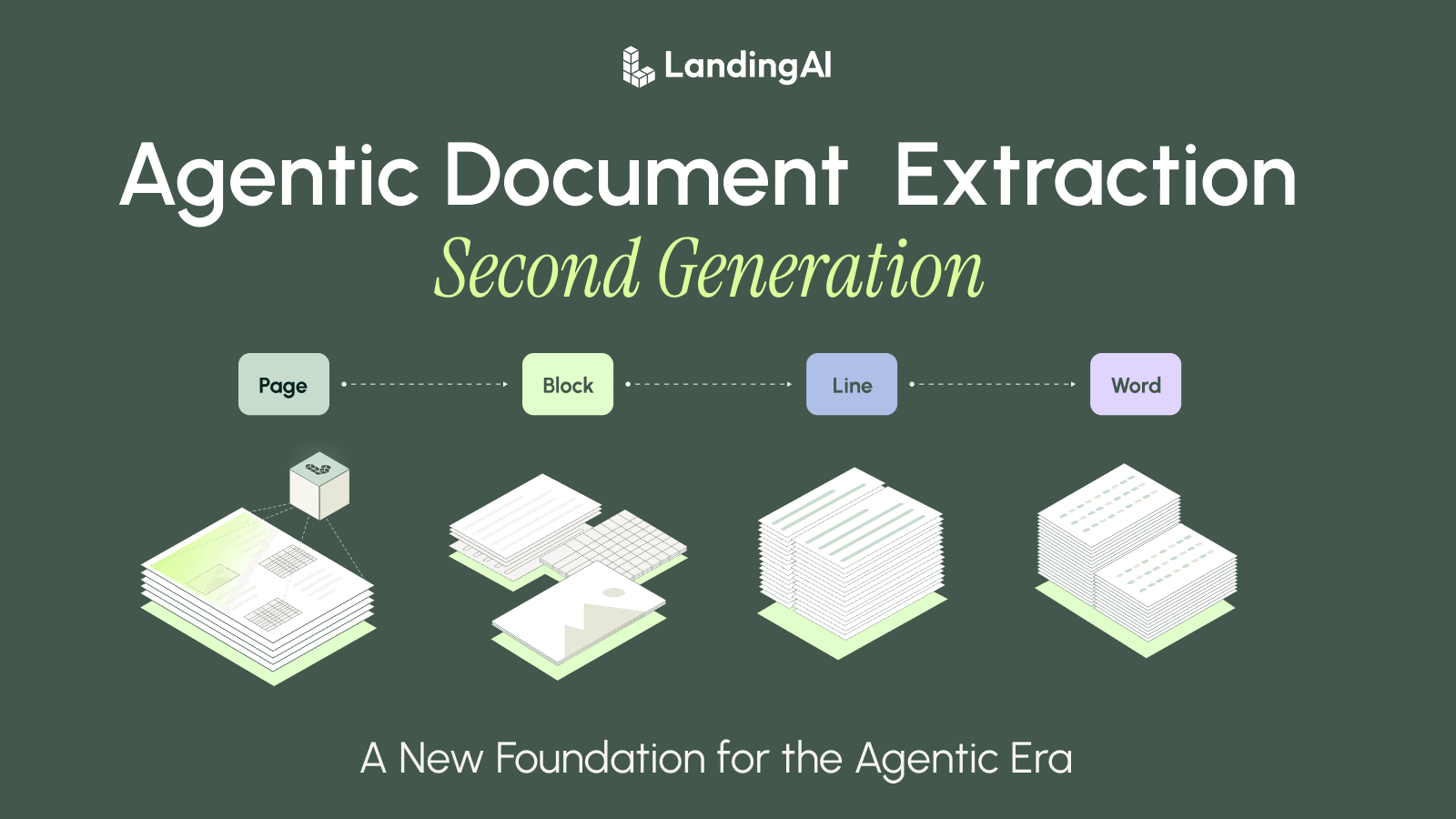
The LandingAI team is thrilled to share an overview of all the innovations bundled into Agentic Document Extraction (2nd Generation). This post will help you understand everything available to you and how to get started using it.
Watch the launch
Rethinking Document Processing for the Agentic Era
Agentic Document Extraction is now faster, more accurate, and more efficient than ever before. From a customer point of view, it delivers higher performance while optimizing cost for every document. Customers are getting a platform with more agent-friendly outputs and more detailed citations that is affordable at scale. This is not an incremental update. It is a fundamental rethink and rebuild of how AI understands and works with documents in the agentic era.
Going forward Agentic Document Extraction will be powered by the DPT-3 family of models which includes DPT-3 Pro and DPT-3 Verity. These new foundational models are built from the ground up to read documents the way a careful human does, starting with overall layout and structure and ending with individual words and table cells. The DPT-3 Parse models have a fully redesigned API response that AI agents love. We've tested the new API response extensively with the new ADE CLI and ADE Claude Skill and found that AI agents are able to build very sophisticated document intelligence workflows and front-end applications with only natural language prompts.
Traditional document processing was built for a pre-agent world. LandingAI's Agentic Document Extraction is built for the agentic era.
Three Themes + A Whole Lot More
Over the past year, you told us exactly what you need from a document processing platform to run your most demanding workloads. You asked and we listened, innovating to reduce costs and building capabilities for pinpoint traceability at scale.
This release has 3 thematic messages to help you understand the new capabilities as a collection. It also has a long list of point improvements in the Overflow section that don't group neatly into a theme. Look for links to more detailed resources where available. Everything discussed here is also documented in the official change log and migration guide.
The themes:
- Affordability at scale: Large price decreases mean you can now automate your whole document mix accurately and economically.
- Agent-ready outputs: We are treating the AI agent as a primary user of Agentic Document Extraction. API outputs are specifically built for AI agents to consume.
- Atomic grounding: The DPT-3 models ground their output far more finely. DPT-3 Pro grounds down to the line, and DPT-3 Verity down to the word, with a confidence score for every word. This opens up many new use cases and downstream applications.
1. Affordability at scale with 25% to 80% lower prices
High accuracy in document intelligence is table stakes. After accuracy is achieved, the next two metrics are typically cost and speed. Agentic Document Extraction Gen2 is built to make your entire document mix economical to automate. We have achieved this via multiple pricing levers.
With all the innovations, we are projecting 25% to 80% cost reductions for customers running mixed workloads. Compared to DPT-2, parsing with DPT-3 Verity on the Standard tier uses 80% to 90% fewer credits for a typical business document such as an invoice.
1A. Variable pricing based on characters returned
Parse has a new core pricing philosophy based on document complexity as measured by output characters. When parsing with the DPT-3 models you pay for the number of characters returned, not the number of pages in the document.
A content-light page costs the minimum and a dense, content-heavy page costs more. Every Parse response reports the output character count and the final credit cost, so you can see exactly what each page cost and why. Users of DPT-2 will recall that each page was priced at a flat 3 credits.
1B. Save money by waiting a little longer
New service tiers allow you to save 50% on your Parse and Extract tasks by waiting. The service tier sets how quickly you get each job back. Priority is intended for when a person or an agent is waiting on the result. Standard is the default; it runs asynchronously and suits production pipelines where a response in the range of minutes to hours is acceptable.
Relative pricing is 1.0x for Priority and 0.5x for Standard.
Note that the ADE Visual Playground uses the Priority service tier since a person (you) is waiting on the result. Cut credit usage in half by switching to API-based usage and using the default, Standard tier.
1C. Select the least expensive, capable model
With this launch we are introducing DPT-3 Pro and DPT-3 Verity (currently in public preview). Both are parsing models, both use complexity-based pricing, and both offer the Priority and Standard service tiers. DPT-3 Verity charges roughly 40% of the credits that DPT-3 Pro charges.
DPT-3 Verity (verity: truth, faithfulness to the source) transcribes digitally created documents exactly as written, deterministically, and returns a confidence score and a bounding box for every word. Use it for high-volume digitally generated files containing primarily text, tables, and simple form fields.
DPT-3 Pro reads the layout of a page before it reads the words, detecting multiple block types from tables and figures to marginalia and signatures and returning them in reading order. Charts and figures are described in detail with generative capabilities. DPT-3 Pro handles scanned and handwritten pages, non-Latin scripts, and math formulas.
You can select which model handles your parsing work based on the complexity of the document. By the Fall of 2026, you'll also have a choice to use automated intelligent routing between models. This is cost optimization designed in, so you don't have to build it yourself.
Recap of what's new
Models
- DPT-3 Pro, a high-accuracy model capable of handling extreme document complexity.
- DPT-3 Verity, a high-accuracy, lower-cost model for transcription of digital text and tables. [Public Preview]
Service Tiers
- Parse offers two service tiers with Standard priced at 0.5x compared to Priority.
- Extract offers two service tiers with Standard priced at 0.5x compared to Priority.
Pricing philosophy
- Complexity-based pricing for Parse. Parse charges variable credits based on the number of characters returned.
- Users have control over which pages and which block types they want included in the output.
Why it matters
The economics often decide which workflows organizations choose to automate at all and how they distribute workloads. When we first launched Agentic Document Extraction we quickly won the difficult workloads, but many customers sent their simpler pages to other document AI services due to price. We simply didn't have compelling pricing for basic pages - which are the majority of pages in most industries.
With the introduction of two parsing models, service tiers, and complexity-based pricing, price per page has come down by as much as 80% and parsing is now possible at less than one cent per page with the Verity model on the Standard tier.
Go deeper into the details
- Understanding pricing core concepts
- Compare v1 and v2 pricing on real documents and use cases
- Understanding service tiers
- Complete credit consumption documentation
2. Agent-ready and agent-friendly outputs
An agent is only as reliable as the context it receives. Agentic Document Extraction Gen2 produces the kind of output agents need. The output is built for machines to consume, meaning that it is predictable and highly structured. The DPT-3 API response is genuinely new, rebuilt from the ground up with AI agents in mind.
For existing customers this means faster delivery of use cases across the enterprise with the help of coding agents. But it also means setting aside the time to make the switch to the new API response structure.
Your code from ADE Gen1 will not work with Gen2. Hopefully the pricing improvements above have already motivated you to migrate. If you are not convinced yet, this section will introduce you to how we think about agent-ready outputs and why they matter.
2A. Logical, hierarchical structure
With this release we are introducing blocks and retiring chunks. A block is a logical grouping of related content on a page. It could be a table, a paragraph of text, or a bar chart together with its title, legend, and caption. Pages contain one or more blocks. The structure is pages → blocks → tables → cells or pages → blocks → lines → words.
Also new: every block carries a stable ID based on its type, and Markdown span pointers locate it on the page. The redesigned API response includes a new top-level object named structure. Within the structure you'll find page, range { start, end }, box { xmin … ymax }, and atomic_grounding. AI agents are able to traverse this structure very easily.
2B. Highly standardized markdown outputs
The Markdown output from both Parse models is now much more highly structured and standardized. This means that customers won't have to plan for multiple edge cases and can expect a conforming response each time.
The most notable changes are for Figures, Attestations, Checkboxes, and Tables.
- Figures use standard image syntax with subtype labels ([Chart], [Diagram], [Photograph], [Illustration]).
- Within Figures, the transcribed text is clearly separated from generated text, with all generated text sitting within the
<description></description>tags. - Attestations are structured as Signed or Not Signed. The verbose descriptions of the past are gone.
- Checkbox outputs are structured and standardized as
[X]or[], including checkboxes inside tables. - Tables can be delivered as HTML, which preserves structure that plain Markdown flattens.
Recap of what's new
Response Structure
- Hierarchical parse layout model
- Stable block IDs and Markdown span pointers that link back to the source
- New v2 Parse API and response structure for DPT-3. Available via the v2 Parse endpoints
- New v2 Extract API and response structure. Available via the v2 Extract endpoints
- More compact output. Cleaner for agents to consume and, because Parse pricing tracks output characters, cheaper too.
Standardization
- Consistent key-value pairs, intact and predictable.
- Standardized Markdown for figures: standard image syntax with subtype labels ([Chart], [Diagram], [Photograph], [Illustration]).
- Standardized Markdown for checkboxes: one consistent representation, including checkboxes inside tables.
- Standardized Markdown for attestations: structured cleanly as Signed or Not Signed.
- Tables are delivered as HTML by default with option to select Markdown instead.
Generative vs Literal Outputs
- For figures, the literal transcription of the text on the figure is kept separate from the model's generated description of it. Customers can always tell which text came directly from the document.
Why it matters
Structured, grounded, predictable output is what lets an agent act on a document without a person re-reading it first. When every value has a stable ID and a pointer back to its place on the page, downstream systems can retrieve, reason, and cross-reference without guessing. And they behave consistently across runs.
Standardized Markdown reduces the chance an agent makes an error due to formatting differences. As a bonus, more signal in fewer characters also lowers costs.
Go deeper into the details
- Understanding the Parse API response shape
- Understanding the structure of pages and blocks
- Find blocks by ID
- Deep dive on detecting signatures, stamps, and seals
3. Atomic grounding, and what it unlocks
Trust and traceability are what make scale safe. A system can read a million pages, but if you can't check any single answer against its source, you can never use that system in a regulated workflow.
In Gen2, we are introducing the term atomic grounding, which is grounding at the smallest structural unit of a document. The Gen2 Parse models both return atomic grounding as part of their response.
The Gen2 Extract model returns atomic citations drawn from the atomic grounding. Atomic citations allow you to trace any extracted value back to a specific word on a specific page. As before, Extract V2 offers you an infinite, fully custom schema with output formatting options. Any schemas you built with Extract V1 will carry over.
All DPT-3 family Parse models offer fine-grained grounding:
- Table-cell grounding works exactly as it did in Gen1 but has become more detailed. Every cell in a table has an identifier that can be referenced. Now each table cell also has a bounding box location associated with it.
- Line-level grounding is returned by DPT-3 Pro. Every text line within a block has its own Markdown span pointers and bounding box coordinates. This applies to all block types.
- Word-level grounding with word-level confidence scores is returned by DPT-3 Verity. Every word has its own Markdown span pointers and bounding box coordinates. Every word has an associated confidence score.
Recap of what's new
- Atomic grounding output from both Parse models.
- DPT-3 Pro at the line level. Page → block → line
- DPT-3 Verity at the word level. Page → block → line → word
- Table-cell grounding now provides bounding box coordinates per table cell.
- Extract V2 returns fine-grained citations drawn from the fine-grained grounding of Parse V2.
Why it matters
Atomic citations are the foundation for a class of capabilities that couldn't be built on DPT-2. Any use case that requires traceability down to the word level now becomes possible. This includes:
- PII and PHI can be localized to the exact line, word, or table cell, then intentionally obscured or removed based on the location coordinates.
- The parse outputs of two documents can be compared and version differences can be localized and highlighted.
- Users can build UIs to rapidly do human reviews of extracted values and/or edit Markdown in place.
Atomic grounding from Parse is what makes each of these buildable. With this level of traceability, organizations can automate more use cases and operate them at higher volumes.
Go deeper into the details
- Understanding atomic grounding
- Understanding the Parse Outputs
Overflow: More in this release
As mentioned before, this is not an incremental update. There are many, many new capabilities to make you aware of that didn't fit neatly into the 3 themes.
Major changes and enhancements not previously covered:
- ADE CLI to parse documents and extract fields from the command line.
- Updated ADE Claude Skill available via the plugin Marketplace.
- New ade-python Python client library carrying the v2 APIs.
- New ade-typescript TypeScript client library carrying the v2 APIs.
- Improved Parse Jobs API for async parsing at scale. Submit large documents (up to 6,000 pages or 1 GB per PDF) and retrieve results when they're ready.
- New Extract Jobs API (to mirror the Parse Jobs API) for asynchronous extraction jobs. Available on the Priority and Standard tiers.
- Separate v2 (DPT-3) documentation not co-mingled with the previous documentation for v1 (DPT-2).
- More Enterprise deployment options. In addition to US and EU cloud, choose from your own VPC on AWS, Azure, or Google Cloud, Snowflake, or on-premises, including air-gapped environments.
Minor changes and enhancements not previously covered:
- New Playground URL at ade.landing.ai. Update your bookmarks.
- Ability to configure Parse options in the Playground to mirror the API
optionsparameter. - Redesigned Usage dashboard. Daily and monthly consumption charts plus per-job logging.
- Ability to set credit usage alerts.
- The Playground user interface offers low-confidence highlighting.
- Improved form handling, especially checkbox detection, including checkboxes inside tables.
- Unified async job model. Parse Jobs and Extract Jobs now share a single response envelope and job-id format, with the option to store job output for later retrieval.
- Standardized error handling. Consistent error responses in a
{"code", "message"}shape. - Correct handling of rotated images. EXIF orientation is now respected, so bounding boxes line up with the document as you see it - important for scans and phone photos.
- Notifications of finished jobs via registered webhooks.
- Ability to restrict API access by IP Address on the Enterprise plan.
For the full list of changes, see the changelog.
A new foundation for document intelligence in the agentic era
ADE Gen2 is a new foundation for the agentic era: autonomous enough to do the reading at scale, auditable enough to trust with the results. Users are getting a new model, a new API response, pricing that makes the whole document mix economical, and grounding that ties every answer back to the page.
This is bigger than automating paperwork. As AI moves from answering questions to executing work, documents become the foundation, and agents can only make good decisions when the information they act on is accurate, grounded, and trustworthy.
ADE Gen2 is available today. We are excited to see what you build with it.
Get started free at ade.landing.ai.