Consolidated 1099s, read end to end
One consolidated 1099 carries five IRS forms. A brokerage bundles 1099-B, 1099-INT, 1099-DIV, 1099-OID and 1099-MISC into a single statement, adds pages of supplemental detail the IRS never asked for, and sends tens or hundreds of pages to anyone with an active account. Fidelity, Schwab, Vanguard, Edward Jones and Robinhood each lay theirs out differently.
Anyone can read the summary boxes. Underneath them sits the transaction detail: every sale, when it was acquired, what it sold for, what it cost, any wash sale adjustment, and whether the holding is short or long term, covered or noncovered. That is what a return is built from.
What makes consolidated 1099s hard
Many forms inside one document
A single statement carries five or more distinct IRS forms, each with its own box numbering and its own rules. Extraction has to keep them apart and know which section a given figure belongs to.
Transaction detail runs for pages
An active account produces hundreds of 1099-B rows across many pages, grouped into short-term and long-term, covered and noncovered sections. The section header decides how every row beneath it is treated.
Every broker formats theirs differently
Box ordering, section naming, page layout and the amount of supplemental detail vary by issuer. Position-based extraction has to be rebuilt for each broker, then re-verified every tax year.
Parse, extract, verify
Parse
Parse turns the document into reading-order Markdown and a hierarchy of blocks (text, tables, figures), and grounds each block to its exact location on the page.
Extract
You define the fields in a JSON schema, and Extract returns their values in a consistent, structured format, each linked back to where it appears in the Markdown.
Verify
Each value links back to where it appears, down to the character range in the Markdown, and the page and bounding box in the source document, so every result can be verified.
One consolidated 1099, end to end
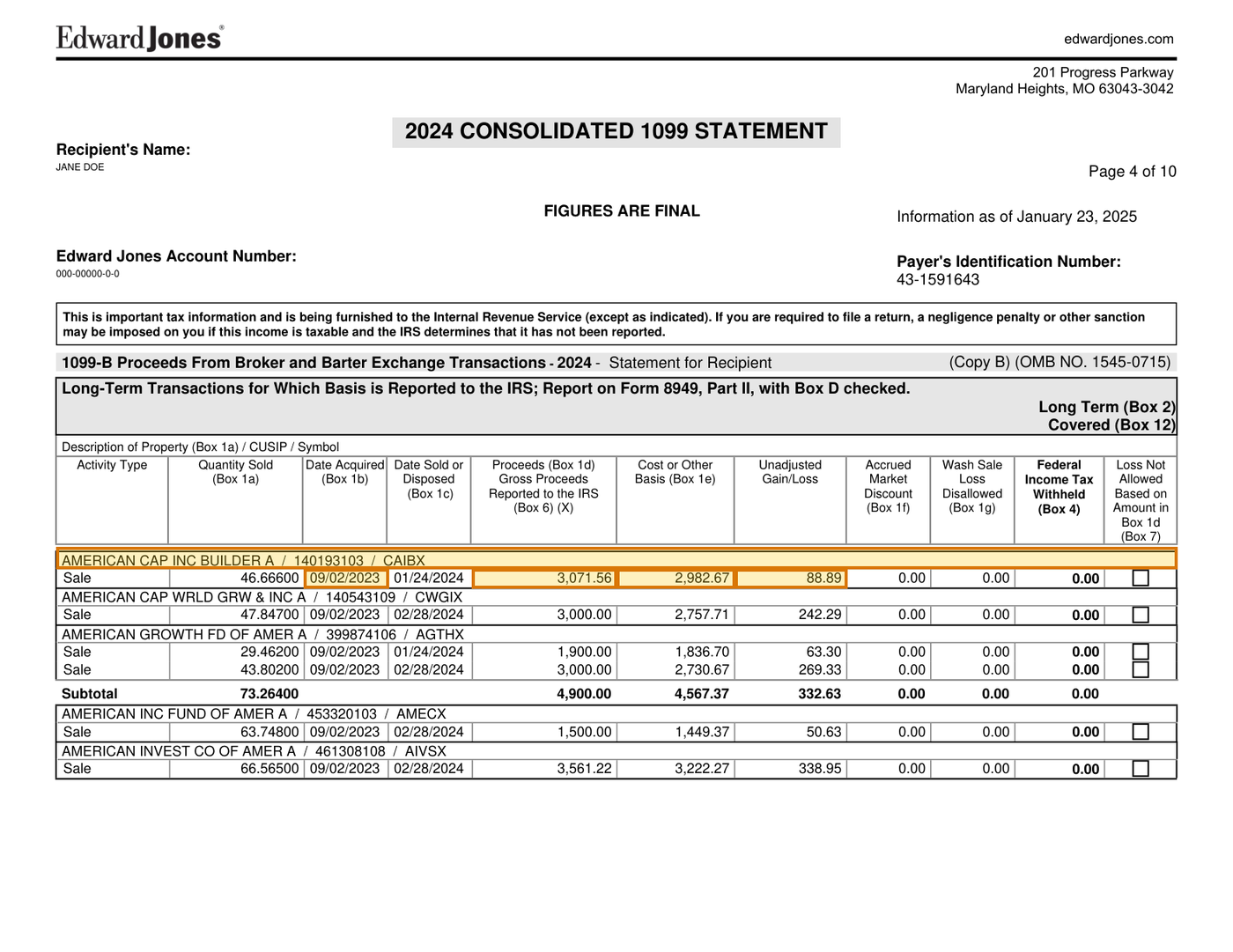
About this document: A 2024 Consolidated 1099 Statement from Edward Jones, 13 landscape pages. It bundles 1099-B, 1099-INT, 1099-DIV, 1099-OID and 1099-MISC, with pages of supplemental detail the IRS does not require. Page 4 carries the long-term 1099-B transactions. This is a real statement. The recipient name, account number and advisor details were replaced with fictitious equivalents before publication, and the page carrying the mailing address was removed.
Task overview: Pull one complete long-term 1099-B transaction off page 4: the security, when it was acquired, what it sold for, what it cost and the resulting gain. A tax preparer reconciles these five fields against the summary boxes, and a filing is built from them.
Fields to extract: Security sold, Date acquired, Gross proceeds, Cost basis, Gain or loss — 5 of 66 fields in the schema, all on page 4.
The document
4 of 13 pages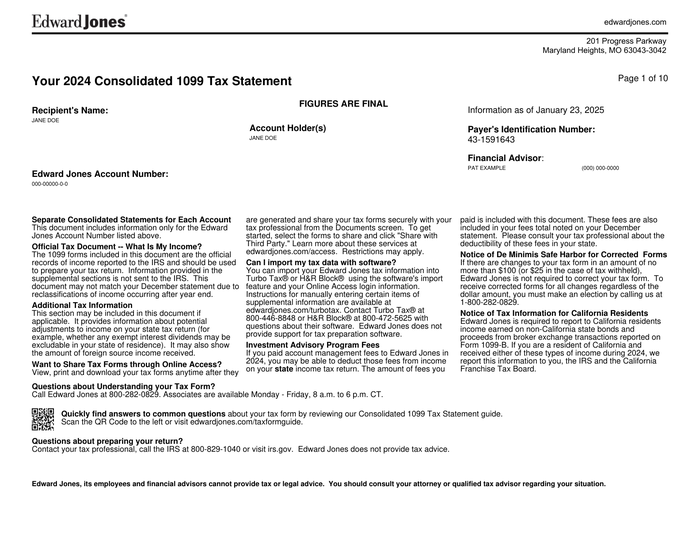 Page 1
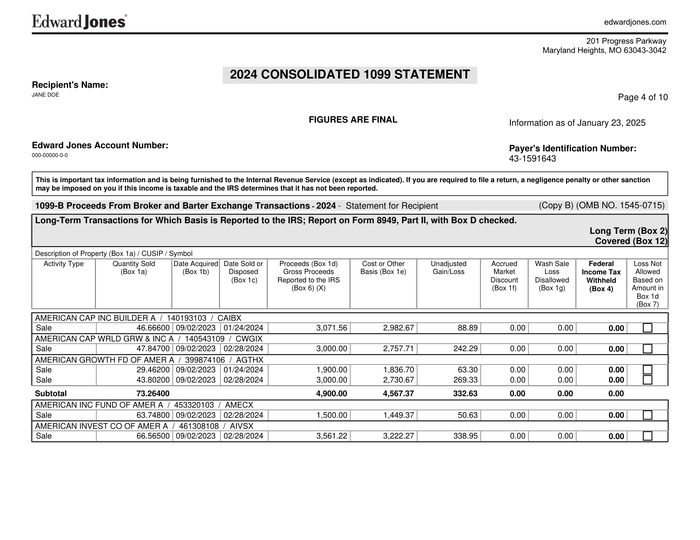 Page 4shown below
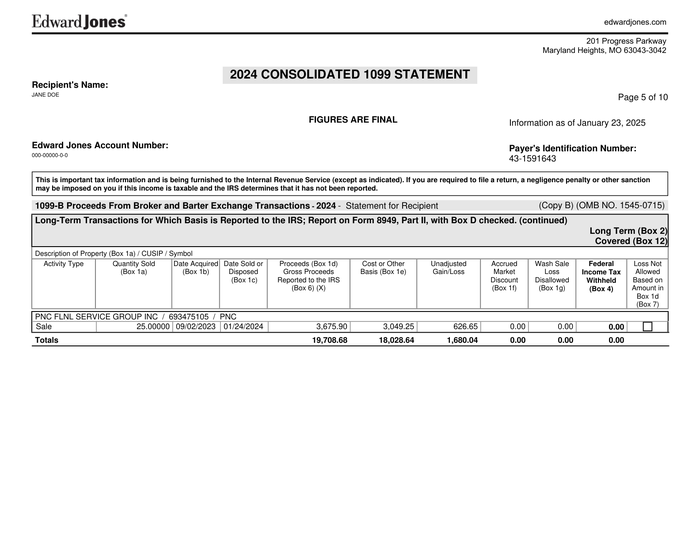 Page 5
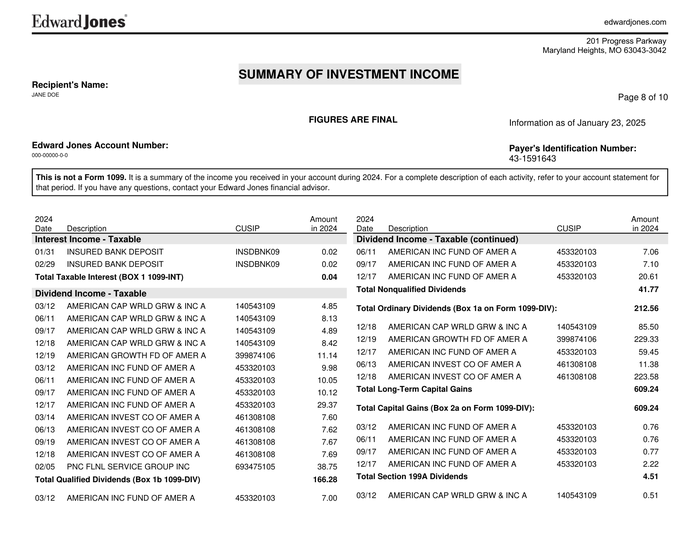 Page 8
Where each value came from
Sample: 2024 Consolidated 1099 Statement, Edward Jones · Personal details in this document were replaced with fictitious equivalents before publication. · Source
form_1099_b.details[1].description_of_property
{
  "value": "AMERICAN CAP INC BUILDER A / 140193103 / CAIBX",
  "page": 4,
  "range": {
    "end": 10942,
    "start": 10896
  },
  "box": {
    "xmin": 0.04563,
    "ymin": 0.57507,
    "xmax": 0.95501,
    "ymax": 0.5976
  }
}form_1099_b.details[1].date_acquired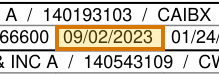
Printed on the page as 09/02/2023, normalized on extraction.
{
  "value": "2023-09-02",
  "page": 4,
  "range": {
    "end": 11001,
    "start": 10991
  },
  "box": {
    "xmin": 0.24673,
    "ymin": 0.59753,
    "xmax": 0.31505,
    "ymax": 0.61772
  }
}form_1099_b.details[1].proceeds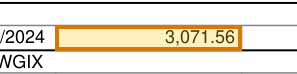
{
  "value": 3071.56,
  "page": 4,
  "range": {
    "end": 11037,
    "start": 11029
  },
  "box": {
    "xmin": 0.38291,
    "ymin": 0.59754,
    "xmax": 0.5006,
    "ymax": 0.61774
  }
}form_1099_b.details[1].cost_basis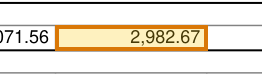
{
  "value": 2982.67,
  "page": 4,
  "range": {
    "end": 11054,
    "start": 11046
  },
  "box": {
    "xmin": 0.50057,
    "ymin": 0.59755,
    "xmax": 0.59613,
    "ymax": 0.61775
  }
}form_1099_b.details[1].gain_or_loss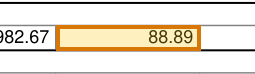
{
  "value": 88.89,
  "page": 4,
  "range": {
    "end": 11068,
    "start": 11063
  },
  "box": {
    "xmin": 0.59611,
    "ymin": 0.59756,
    "xmax": 0.68701,
    "ymax": 0.61776
  }
}
How to try it yourself
Everything on this page is reproducible. The sample, its schema, and the Parse and Extract API outputs are published. You can repeat the same two calls from whichever surface you already build on.
- Claude Skilldescribe the job; the agent writes it
- CLIno code at all
- MCPexpose ADE docs as an agent tool
- REST APIany language
- Pythonlandingai-ade
- TypeScriptlandingai-ade
Documents into data
Accurate
The best accuracy on the difficult documents other tools get wrong, such as messy scans, complicated tables, checkboxes and handwriting.
Auditable
Every answer cites its sources. Values come back with an audit trail (page, bounding box, character range) so a human can review them.
Agentic
Applies multi-step reasoning, and plans before it acts. Handles documents it has never seen before and adapts to variations.
API-first
Composable APIs that drop into any tech stack and can be called from anywhere. Easy to build on and embed in your pipelines and products.
Affordable
Cost-competitive rates with complete price transparency. Spend controls before you run, and every job reports its exact cost.
Enterprise-grade
Built for production and scale from day one. Fully observable and monitored, running securely in our cloud or yours.
Built for high-volume, high-throughput production
- Zero data retention
- Priority rate limits
- Enhanced support
- VPC and on-prem deployment
Available on Team and Enterprise plans.